
Getting your warehouse fit-out design right starts long before installation. From product types and workflow to forklift access and future expansion, every detail impacts performance and cost.
At Shelving Depot, we’re often asked how to create a warehouse layout that’s efficient, compliant, and scalable.
Here’s what we cover with our clients and what you should consider as well.
Shelving vs Racking: Which Is Right for Your Warehouse?
There’s no one-size-fits-all answer, but two key factors help guide the choice.
1. Product handling
- If your product is small, fast-moving, or picked frequently, shelving systems are often faster and easier.
- Forklift access slows things down, especially when pallets need to be lowered and returned just to grab one item.
- If pallets go in and out as-is, pallet racking is usually the better fit.
2. Consent and operating costs
- Pallet racking often requires council consent, which can result in additional costs, including emergency lighting, building upgrades, and inspections.
- It also requires trained staff, forklifts, and ongoing maintenance.
- In contrast, shelving is a one-time investment with no consent costs or licensing required, meaning simpler onboarding and lower labour costs.
Tip: If both systems work for your product, always compare the total cost, not just the upfront price.
Planning for Capacity and Workflow
Minor layout tweaks can unlock significant gains in space and efficiency.
Optimise aisle widths
Narrower aisles can make room for significantly more storage, sometimes up to 30% more. We’ll often challenge existing equipment preferences if there’s a clear space-saving advantage.
Use zones for better flow.
Sometimes a mix of shelving and racking is required. This can be achieved by having pallet racking with integrated shelves lower down. When considering this design, it is worth testing a layout that features a dedicated area for pallets only and a separate area for shelving.
By having zones, you can use narrower aisles where the shelving is located and sometimes achieve a better overall capacity and flow.
Racking Orientation
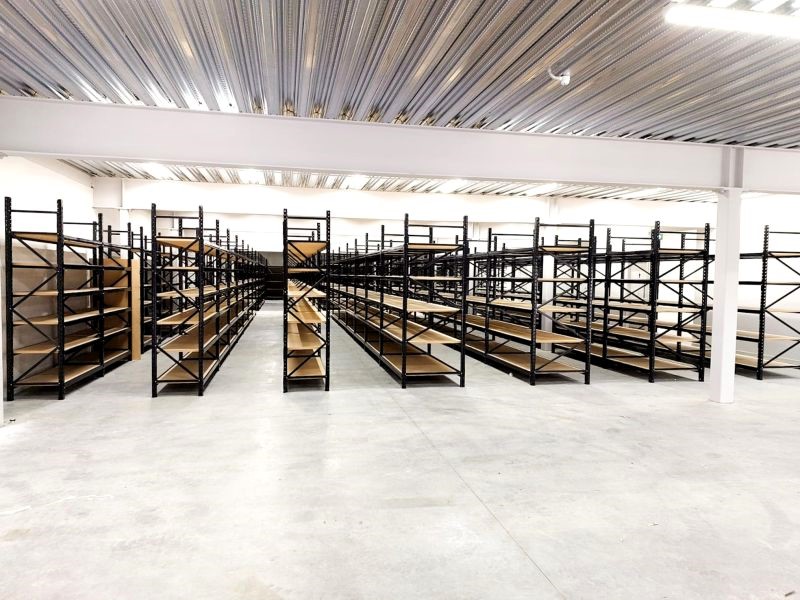
The direction your racking runs (lengthwise vs widthwise) makes a bigger difference than most people expect. This is not only because of the floor configuration but also because the roof pitch in some buildings will impact designs differently.
We always test both horizontal and vertical configurations. In some cases, switching orientation can add more pallet positions, even without changing your equipment or footprint.
Handling Equipment & Forklifts
The choice of handling equipment and forklifts is one of the most influential factors in a warehouse fit-out. So that we can provide the best advice, we make it our business to stay up to date on the forklifts and order pickers that are available in the market.
There are common forklifts that are often used that do not necessarily provide the best solution. The speed of product movement, budget, and long-term strategy should all be considered when choosing equipment for your warehouse. To get the design right, the racking layout and equipment should be assessed together.
Case Study: Custom Storage Solution for a Tech Products Warehouse
We recently helped a client in the tech industry who was running out of space. Their standard racking wasn’t suitable for some irregular-sized items, limiting capacity.
After testing different layouts, we recommended a custom pallet racking solution for a single zone of their warehouse. This minor change:
- Freed up more space
- Improved picking access
- Extended the useful lifespan of their current facility
This solution gave them the breathing room to delay a costly relocation, saving time and capital.
Ready to Plan Your Warehouse Fitout?
Whether you’re moving into a new space or upgrading your current one, Shelving Depot can help you:
- Choose the right systems
- Avoid hidden consent costs
- Maximise storage without over-investing
Contact our team today, and we’ll take care of it.